
When I started researching and recording family history, I only wanted to capture what my parents and their siblings knew. Three of my grandparents had died before I was born. Both of my grandfathers–Antoni Maciejewski and Jan Skrok— died in 1936. My grandmother Marya Szczepańska Maciejewska died in 1951, four years before my birth. The only grandmother I knew–Agnieszka Witoń Skrok Kiec–died in 1977. You can see them in a chart of my ancestors at the top of my blog.
In the early 1990s, I asked questions of my parents and other relatives, recorded what I was told, and shared these family details with interested family members. I even wrote a book about the Descendants of Martin and Anna Szczepański.
These days much of my family history research involves looking at my DNA matches. We know that to pass on those segments of DNA to each of us, our ancestors must have been in the same place at the same time. In the old days, that is how all babies were made! So I look at my matches, their trees, their ethnicity, and our matches in common, and wonder who, or where, our common ancestors may have been.
While I have DNA matches all over the world, most of my relatives who have tested DNA, especially with Ancestry.com, have immigrant ancestors who came to North America in the late 1800s or early 1900s, as mine did. In addition to Buffalo, where my ancestors settled, relatives immigrated to New York, New Jersey, Pennsylvania, New England, the Midwest, especially Chicago, Detroit, Cleveland, and Polish enclaves all over the continent. In 2022, Ewa Barczyk published Footprints of Polonia: Polish Historical Sites Across North America. I have DNA relatives in most of the locations she lists.
Some of my DNA matches have family trees, and it is easy to see their immigrant ancestors’ names, where they were from, and where they settled in the new world. Others are more challenging, and require more work. I use all the clues that are available.
On Ancestry, I start with the test taker’s name and profile. While my public Ancestry account is smp_family for privacy reasons, I share my full name when I contact my DNA matches. My profile includes information about where I live, my approximate age, and what I am researching, as well as how to learn more and contact me.
I indicate I am open to collaborating and working with others to further family research, as well as offer advice and share my expertise with new researchers.
If I find anything interesting in my matches’ trees or my research trees, I often share it in a message to my matches. Not everyone reads their Ancestry messages, of course. Some people test their DNA once, look at their results, and they’re done. Others read the messages, but do not respond. If we are lucky, my matches and I begin a collaboration which helps both of us learn more about our ancestors.
A number of my DNA matches have ancestors who came from West Prussia, and match on my paternal side. Others match on my maternal side and have ancestors who came from the Radom gubernia of Russian Poland. That makes sense. My ancestors came from these places.
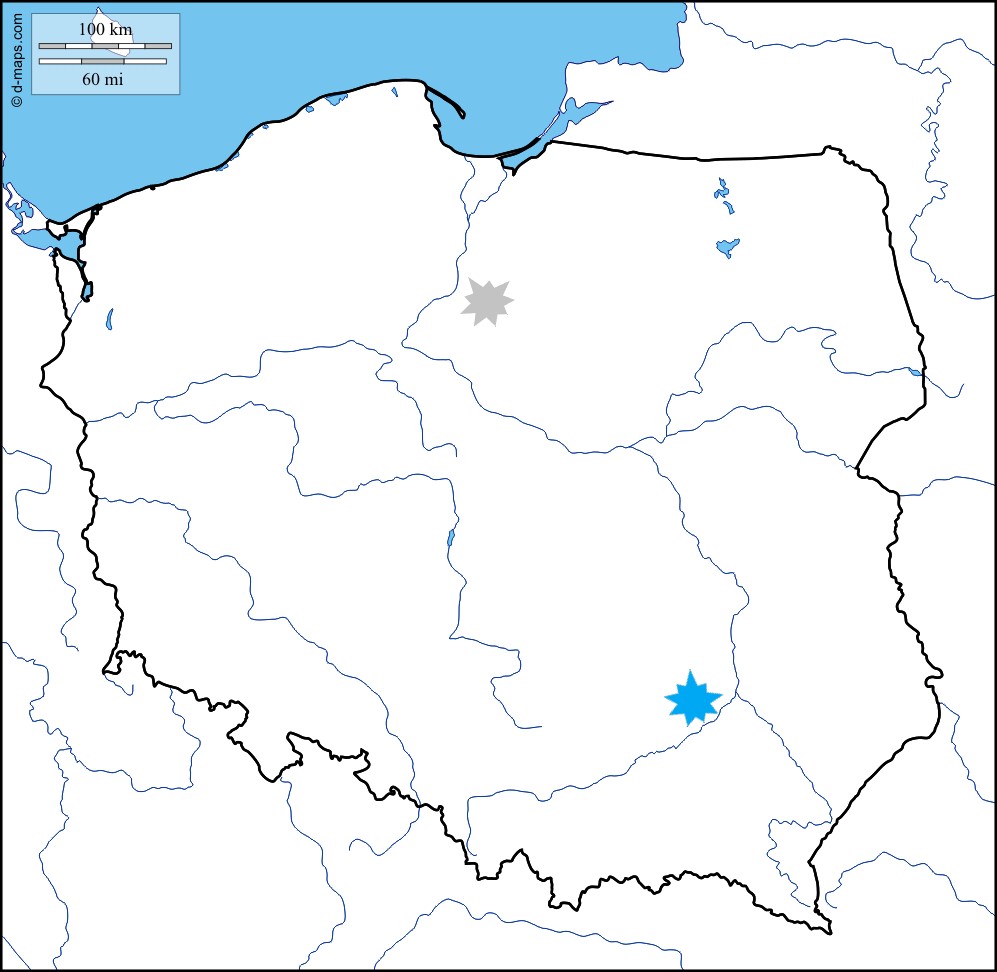
My mother’s ancestors were from Radom in the Russian partition, near the confluence of the Wisła [Vistula] and San Rivers.
Paternal Matches
My paternal ancestors came from the area near Toruń. Today this is the Kujawsko-Pomorskie [Kuyavian–Pomeranian] Voivodeship, from the historic Kujawy and Pomorze regions. The Kujawsko-Pomorskie Voivodeship was formed in 1999 from the previous Bydgoszcz, Toruń, and Włocławek Voivodeships.
In addition to matches whose ancestors emigrated from West Prussia, a surprising number of my matches have ancestors who emigrated from the Russian partition, especially the Mazowieckie [Masovian] and Podlaskie Voivodeships in modern Poland.
I also have a cluster of distant matches whose ancestors were German from West Prussia. One family even had a history of how their ancestor was recruited from Germany and given land in West Prussia. A few of them had wives with Polish names in the late 18th and early 19th centuries.
Maternal Matches
My maternal ancestors emigrated from the areas of Sandomierz and Opatów in the current Świętokrzyskie [Holy Cross] Voivodeship. Many of my maternal DNA matches had ancestors from Galicia, the northern province of the Austria-Hungarian Empire. Today, this is south-eastern Poland from the Kraków area to western Ukraine.
Does Ancestry Get it Right?
While these are the typical patterns, I have distant matches that do not fit. Using DNA, Ancestry identifies my matches as paternal, maternal, or both. I have some “paternal” matches whose ancestors were from the southern part of Poland. Some “maternal” matches have ancestors from northern Poland.
While a few of these differences may be due to misattributed parentage or error, more may be related to migration patterns in Europe through centuries.
For example, a sub-ethnic group called the Lasowiacy [Forest People] occupied the area south of Sandomierz, between the Wisła [Vistula] and San Rivers. Heather Pedersen, in her Galicia Genealogy blog, wrote “The Lasowiacy: An Introduction.” She explains:
In the 15th and 16th centuries, the kings of Poland had settlers from other areas, largely from Masuria (northern Poland), move to the Sandomierz Forest to begin to colonize it. The King additionally ordered Tartar, Ruthenian and Turkish prisoners of war to settle the area as well. In the 1770s and 1780s, colonists from Germany arrived in this region.
In his 1939 book Sztafeta, author Melchior Wańkowicz wrote that “the people in this village call themselves Lasowiacy, speaking a funny accent, which sounds like a mix of Goral dialect, and the language of Kurpie.” The Gorale [Highlanders] were from the Carpathian mountains in southern Poland bordering Slovakia and Czechia. The Kurpie people were an ethnic group from the Mazowsze [Mazovian] Region of east-central Poland.
I have distant DNA matches whose ancestors immigrated from Slovakia, as well as some “maternal” matches whose immigrant ancestors can be traced back to the villages near Myszyniec and Ostrołęka in Mazowieckie [Masovian] Voivodeship in northeastern Poland.
Looking at my DNA matches has been an education in both history and geography. I have learned more about the places of Polonia in North America, as well as the history and geography of Poland.
 My Family History Research
Leave a comment